OCR
Text read from pictures in pure Rust: photos and scans of documents, receipts, labels and screenshots to plain text, row by row or line by line with boxes, parts of the page read by range (pixels or percentages), several form fields at once, only the characters you allow, and phone photos turned upright first.
Version 1.0.0 · 6 functions · 6 crates
Functions
What use ocr.qwer gives a program, with the types Quillo sees. To take only some, or under other names: use ocr_text, ocr_lines from ocr (Quillo 0.6).
ocr_text(path: str) → stror an errorThe text in the picture at path, line by line in reading order, joined by newlines. "" when there is none.
ocr_lines(path: str) → anyor an errorThe lines of text in the picture at path, in reading order: [{ text, x, y, width, height, words }], boxes in the picture's pixels, each word { text, x, y, width, height }; for finding a field by where it is (the total at the right).
ocr_read(path: str, options: any) → anyor an errorThe picture at path read with options: chars (only these characters may be read, e.g. "0123456789."), scale (enlarge small or low-resolution pictures, e.g. 2.0), range ({ x, y, width, height }: read only that part, each in pixels or as a percentage of the picture like "50%"; width and height left out run to the edge), order ("reading", the default: column by column; "rows": row by row, a receipt's item and price on one line), min_length (drop lines shorter than this, default 2: specks read as letters). { text, lines, width, height, range, seconds }, boxes always in the whole picture's pixels, range the part read in pixels (null for all of it).
ocr_ranges(path: str, ranges: map, options: any) → anyor an errorSeveral parts of the picture at path read at once, for forms whose fields are always in the same place: ranges maps a name to a range (as ocr_read's range, or { range, chars, scale } to give that field its own options), and the answer maps each name to its text. options (chars, scale, min_length) apply to every range that does not set its own.
ocr_read_base64(data: str, options: any) → anyor an errorAs ocr_read, for a picture given as base64 or as a data:image/...;base64, URL: a camera capture or a pasted screenshot.
ocr_models(download: bool) → anyor an errorWhere the models are, { dir, ready, files }: with download true they are fetched first if missing (12 MB, once), so a deploy can get them before the first picture arrives. OCR_MODELS names another folder.
Get it
$ quillo install ocr # ocr.qwer into this folder$ quillo install ocr --example # and its example, ocr.qweOr with curl:
$ curl -O https://quillolang.org/plugins/files/ocr.qwer$ curl -O https://quillolang.org/plugins/files/ocr.qwe$ curl -O https://quillolang.org/plugins/files/ocr_sample.pngThen, in your program, all of it or only what you call:
use ocr.qweruse ocr_text, ocr_lines from ocr // Quillo 0.6: only theseIt uses these crates, which cargo fetches the first time the plugin is built:
ocrs = "=0.13.1"rten = "=0.26.0"image = { version = "0.25", default-features = false, features = ["png", "jpeg", "webp", "gif", "bmp", "tiff"] }ureq = "2"base64 = "0.22"serde_json = { version = "1", features = ["preserve_order"] }Example
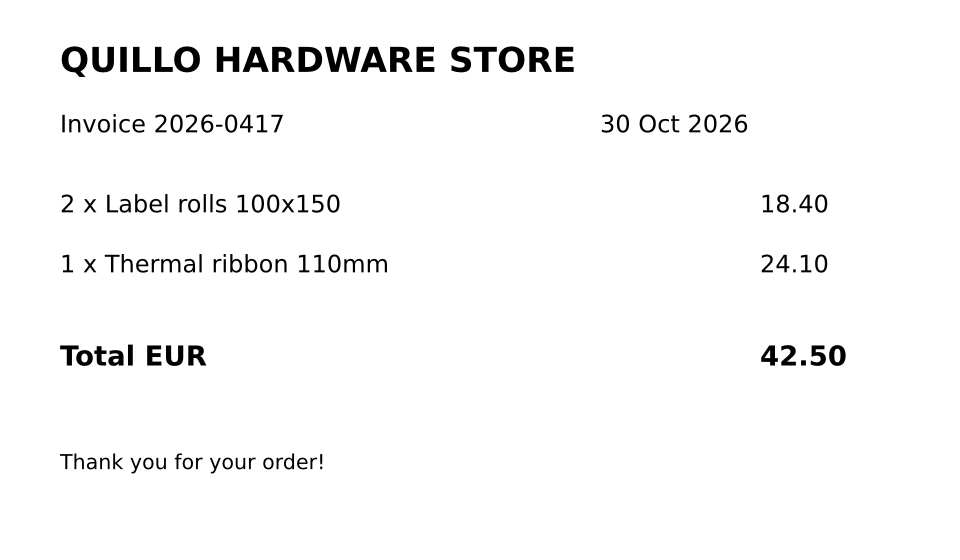
// An invoice photographed or scanned, read: all its text, its lines with where they are,// and its fields by the part of the page they are always in.//// quillo run ocr.qwe then open http://localhost:8080/text//// The first picture read downloads the two models (12 MB) into ~/.cache/quillo/ocr, once;// GET /models gets them ahead of time. OCR_MODELS names another folder for them.use "ocr.qwer"route GET /text = ocr_text("ocr_sample.png")route GET /lines = ocr_lines("ocr_sample.png") | map((l) => { text: l.text, x: l.x, y: l.y, words: len(l.words) })// Row by row, as a receipt is read: each item with its price.route GET /rows = ocr_read("ocr_sample.png", { order: "rows" }).text// The amount at the right of the total's line: only digits and the point may be read.route GET /total = { let r = ocr_read("ocr_sample.png", { range: { x: "75%", y: "58%", height: "12%" }, chars: "0123456789." }) { total: r.text, range: r.range, seconds: r.seconds }}// A form's fields, each where it always is on the page.route GET /fields = ocr_ranges("ocr_sample.png", { invoice: { x: 0, y: "18%", width: "55%", height: "9%" }, date: { x: "60%", y: "18%", height: "9%" }, total: { range: { x: "75%", y: "58%", height: "12%" }, chars: "0123456789." },}, {})route GET /models = ocr_models(true)$ quillo run ocr.qwe$ curl 'localhost:8080/text'$ curl 'localhost:8080/rows'$ curl 'localhost:8080/total'$ curl 'localhost:8080/fields'Source
//! Text read from pictures (OCR), in pure Rust: photos of documents, receipts, labels and screenshots to plain text, or to lines and words with their boxes, phone photos turned upright first; English printed text, and only the characters you allow when you know what to expect (digits for a meter, capitals for a plate).//! version: 1.0.0//!//! [dependencies]//! ocrs = "=0.13.1"//! rten = "=0.26.0"//! image = { version = "0.25", default-features = false, features = ["png", "jpeg", "webp", "gif", "bmp", "tiff"] }//! ureq = "2"//! base64 = "0.22"//! serde_json = { version = "1", features = ["preserve_order"] }use base64::Engine as _;use image::{DynamicImage, ImageDecoder, ImageReader};use ocrs::{ImageSource, OcrEngine, OcrEngineParams, TextItem};use serde_json::{json, Value};use std::collections::HashMap;use std::io::{Cursor, Read};use std::path::PathBuf;use std::sync::{Arc, Mutex, OnceLock};// The models of the ocrs project (https://github.com/robertknight/ocrs-models), fetched once.const MODELS: [(&str, &str); 2] = [ ("text-detection.onnx", "https://ocrs-models.s3-accelerate.amazonaws.com/text-detection.onnx"), ("text-recognition.onnx", "https://ocrs-models.s3-accelerate.amazonaws.com/text-recognition.onnx"),];fn models_dir() -> PathBuf { if let Ok(d) = std::env::var("OCR_MODELS") { if !d.is_empty() { return PathBuf::from(d); } } let base = std::env::var_os("XDG_CACHE_HOME") .map(PathBuf::from) .or_else(|| std::env::var_os("HOME").map(|h| PathBuf::from(h).join(".cache"))) .unwrap_or_else(std::env::temp_dir); base.join("quillo").join("ocr")}// Each model downloaded beside its final name and moved there whole, so a broken download is never loaded.fn fetch_models() -> Result<PathBuf, String> { static LOCK: Mutex<()> = Mutex::new(()); let _held = LOCK.lock().unwrap_or_else(|e| e.into_inner()); let dir = models_dir(); for (name, url) in MODELS { let path = dir.join(name); if path.exists() { continue; } std::fs::create_dir_all(&dir).map_err(|e| format!("cannot make {}: {}", dir.display(), e))?; let res = ureq::get(url).timeout(std::time::Duration::from_secs(300)).call() .map_err(|e| format!("cannot download the OCR model {} ({}); or put it in {} yourself, or set OCR_MODELS", name, e, dir.display()))?; let mut bytes = Vec::new(); res.into_reader().take(64 << 20).read_to_end(&mut bytes).map_err(|e| format!("downloading {}: {}", name, e))?; if bytes.len() < 100_000 { return Err(format!("the OCR model {} came back with only {} bytes", name, bytes.len())); } let part = dir.join(format!("{}.part", name)); std::fs::write(&part, &bytes).map_err(|e| format!("cannot write {}: {}", part.display(), e))?; std::fs::rename(&part, &path).map_err(|e| format!("cannot write {}: {}", path.display(), e))?; } Ok(dir)}// One engine per set of allowed characters, kept: loading the models takes a moment.fn engine(chars: Option<&str>) -> Result<Arc<OcrEngine>, String> { static ENGINES: OnceLock<Mutex<HashMap<String, Arc<OcrEngine>>>> = OnceLock::new(); let engines = ENGINES.get_or_init(|| Mutex::new(HashMap::new())); let key = chars.unwrap_or("").to_string(); if let Some(e) = engines.lock().unwrap_or_else(|e| e.into_inner()).get(&key) { return Ok(e.clone()); } let dir = fetch_models()?; let load = |name: &str| rten::Model::load_file(dir.join(name)).map_err(|e| format!("cannot load the OCR model {}: {}", name, e)); let e = OcrEngine::new(OcrEngineParams { detection_model: Some(load(MODELS[0].0)?), recognition_model: Some(load(MODELS[1].0)?), allowed_chars: chars.filter(|c| !c.is_empty()).map(|c| c.to_string()), ..Default::default() }) .map_err(|e| e.to_string())?; let e = Arc::new(e); engines.lock().unwrap_or_else(|e| e.into_inner()).insert(key, e.clone()); Ok(e)}// A picture from its bytes, turned as its EXIF orientation says (phone photos are often stored on their side).fn decode(bytes: &[u8]) -> Result<DynamicImage, String> { let reader = ImageReader::new(Cursor::new(bytes)).with_guessed_format().map_err(|e| e.to_string())?; let mut decoder = reader.into_decoder().map_err(|e| format!("not a picture this can read: {}", e))?; let orientation = decoder.orientation().ok(); let mut img = DynamicImage::from_decoder(decoder).map_err(|e| format!("cannot read the picture: {}", e))?; if let Some(o) = orientation { img.apply_orientation(o); } Ok(img)}fn num(options: &Value, key: &str) -> Option<f64> { options.get(key).and_then(|v| v.as_f64())}// One side of a range in pixels: a number is pixels, `"25%"` a share of the picture's `full` side.fn side(v: Option<&Value>, full: u32) -> Result<Option<u32>, String> { let px = match v { None | Some(Value::Null) => return Ok(None), Some(Value::Number(n)) => n.as_f64().unwrap_or(0.0), Some(Value::String(t)) => match t.trim().strip_suffix('%') { Some(p) => p.trim().parse::<f64>().map_err(|_| format!("`{}` is not a percentage", t))? / 100.0 * full as f64, None => t.trim().parse::<f64>().map_err(|_| format!("`{}` is not pixels or a percentage", t))?, }, Some(other) => return Err(format!("{} is not pixels or a percentage", other)), }; Ok(Some(px.round().clamp(0.0, full as f64) as u32))}// The part of the picture a `range` names, `(x, y, width, height)` in pixels: width and height left out run to the edge.fn range_of(range: &Value, w: u32, h: u32) -> Result<(u32, u32, u32, u32), String> { if !range.is_object() { return Err(format!("a range is {{ x, y, width, height }}, not {}", range)); } let x = side(range.get("x"), w)?.unwrap_or(0); let y = side(range.get("y"), h)?.unwrap_or(0); let rw = side(range.get("width"), w)?.unwrap_or(w - x).min(w - x); let rh = side(range.get("height"), h)?.unwrap_or(h - y).min(h - y); if rw == 0 || rh == 0 { return Err(format!("the range {} is empty in a {}×{} picture", range, w, h)); } Ok((x, y, rw, rh))}fn read(img: DynamicImage, options: &Value) -> Result<Value, String> { let started = std::time::Instant::now(); let mut img = img; let (full_w, full_h) = (img.width(), img.height()); let (mut dx, mut dy) = (0.0, 0.0); let mut range = Value::Null; if let Some(r) = options.get("range").filter(|r| !r.is_null()) { let (x, y, w, h) = range_of(r, full_w, full_h)?; img = img.crop_imm(x, y, w, h); (dx, dy) = (x as f64, y as f64); range = json!({ "x": x, "y": y, "width": w, "height": h }); } let scale = num(options, "scale").unwrap_or(1.0); if !(0.1..=8.0).contains(&scale) { return Err(format!("scale {} is out of range: 0.1 to 8", scale)); } if scale != 1.0 { let (w, h) = (((img.width() as f64) * scale).round().max(1.0) as u32, ((img.height() as f64) * scale).round().max(1.0) as u32); img = img.resize_exact(w, h, image::imageops::FilterType::CatmullRom); } let rgb = img.into_rgb8(); let (width, height) = rgb.dimensions(); let chars = options.get("chars").and_then(|v| v.as_str()); let min_length = num(options, "min_length").unwrap_or(2.0).max(1.0) as usize; let engine = engine(chars)?; let source = ImageSource::from_bytes(rgb.as_raw(), (width, height)).map_err(|e| e.to_string())?; let input = engine.prepare_input(source).map_err(|e| e.to_string())?; let words = engine.detect_words(&input).map_err(|e| e.to_string())?; let line_boxes = engine.find_text_lines(&input, &words); let found = engine.recognize_text(&input, &line_boxes).map_err(|e| e.to_string())?; // Boxes in the caller's picture: undo the scale, add the range's corner back. let place = |item: &dyn TextItem| { let r = item.bounding_rect(); let s = |v: i32| ((v as f64) / scale).round() as i64; json!({ "x": s(r.left()) + dx as i64, "y": s(r.top()) + dy as i64, "width": s(r.width()), "height": s(r.height()) }) }; let mut lines = Vec::new(); for line in found.iter().flatten() { let text = line.to_string(); if text.trim().chars().count() < min_length { continue; } let mut out = place(line); let ws: Vec<Value> = line.words().map(|w| { let mut b = place(&w); b.as_object_mut().unwrap().insert("text".into(), json!(w.to_string())); b }).collect(); let m = out.as_object_mut().unwrap(); m.insert("text".into(), json!(text.trim())); m.insert("words".into(), Value::Array(ws)); let mut ordered = serde_json::Map::new(); for k in ["text", "x", "y", "width", "height", "words"] { ordered.insert(k.into(), m.remove(k).unwrap()); } lines.push(Value::Object(ordered)); } let rows = match options.get("order").and_then(|v| v.as_str()) { None | Some("reading") => false, Some("rows") => true, Some(o) => return Err(format!("order `{}` is not \"reading\" or \"rows\"", o)), }; let text = if rows { by_rows(&mut lines) } else { lines.iter().map(|l| l["text"].as_str().unwrap_or("")).collect::<Vec<_>>().join("\n") }; Ok(json!({ "text": text, "lines": lines, "width": full_w, "height": full_h, "range": range, "seconds": (started.elapsed().as_secs_f64() * 1000.0).round() / 1000.0, }))}// Lines sorted into rows, top to bottom and left to right, as a receipt or a table is read: a line joins the row whose// middle it covers. The text has a row on each line, its pieces two spaces apart (`2 x Label rolls 18.40`).fn by_rows(lines: &mut Vec<Value>) -> String { let n = |l: &Value, k: &str| l[k].as_i64().unwrap_or(0); lines.sort_by_key(|l| (n(l, "y") + n(l, "height") / 2, n(l, "x"))); let mut rows: Vec<Vec<Value>> = Vec::new(); for l in lines.drain(..) { let mid = n(&l, "y") + n(&l, "height") / 2; match rows.last_mut() { Some(row) if row.iter().any(|r| mid >= n(r, "y") && mid <= n(r, "y") + n(r, "height")) => row.push(l), _ => rows.push(vec![l]), } } let mut text = Vec::new(); for row in rows.iter_mut() { row.sort_by_key(|l| n(l, "x")); text.push(row.iter().map(|l| l["text"].as_str().unwrap_or("").to_string()).collect::<Vec<_>>().join(" ")); lines.extend(row.drain(..)); } text.join("\n")}fn read_path(path: &str) -> Result<DynamicImage, String> { let bytes = std::fs::read(path).map_err(|e| format!("cannot read {}: {}", path, e))?; decode(&bytes)}/// The text in the picture at `path`, line by line in reading order, joined by newlines. `""` when there is none.pub fn ocr_text(path: &str) -> Result<String, String> { Ok(read(read_path(path)?, &json!({}))?["text"].as_str().unwrap_or("").to_string())}/// The lines of text in the picture at `path`, in reading order: `[{ text, x, y, width, height, words }]`, boxes in the/// picture's pixels, each word `{ text, x, y, width, height }`; for finding a field by where it is (the total at the right).pub fn ocr_lines(path: &str) -> Result<Value, String> { Ok(read(read_path(path)?, &json!({}))?["lines"].clone())}/// The picture at `path` read with `options`: `chars` (only these characters may be read, e.g. `"0123456789."`),/// `scale` (enlarge small or low-resolution pictures, e.g. `2.0`), `range` (`{ x, y, width, height }`: read only that part,/// each in pixels or as a percentage of the picture like `"50%"`; width and height left out run to the edge),/// `order` (`"reading"`, the default: column by column; `"rows"`: row by row, a receipt's item and price on one line),/// `min_length` (drop lines shorter than this, default 2: specks read as letters). `{ text, lines, width, height, range, seconds }`,/// boxes always in the whole picture's pixels, `range` the part read in pixels (null for all of it).pub fn ocr_read(path: &str, options: serde_json::Value) -> Result<Value, String> { read(read_path(path)?, &options)}/// Several parts of the picture at `path` read at once, for forms whose fields are always in the same place: `ranges` maps a/// name to a range (as `ocr_read`'s `range`, or `{ range, chars, scale }` to give that field its own options), and the answer/// maps each name to its text. `options` (`chars`, `scale`, `min_length`) apply to every range that does not set its own.pub fn ocr_ranges(path: &str, ranges: std::collections::HashMap<String, serde_json::Value>, options: serde_json::Value) -> Result<Value, String> { let img = read_path(path)?; let mut out = serde_json::Map::new(); let mut names: Vec<&String> = ranges.keys().collect(); names.sort(); for name in names { let spec = &ranges[name]; let mut o = if options.is_object() { options.clone() } else { json!({}) }; if spec.get("range").is_some() { for (k, v) in spec.as_object().unwrap() { o[k] = v.clone(); } } else { o["range"] = spec.clone(); } let r = read(img.clone(), &o).map_err(|e| format!("{}: {}", name, e))?; out.insert(name.clone(), r["text"].clone()); } Ok(Value::Object(out))}/// As `ocr_read`, for a picture given as base64 or as a `data:image/...;base64,` URL: a camera capture or a pasted screenshot.pub fn ocr_read_base64(data: &str, options: serde_json::Value) -> Result<Value, String> { let b64 = match data.split_once(";base64,") { Some((_, rest)) => rest, None => data, }; let clean: String = b64.chars().filter(|c| !c.is_whitespace()).collect(); let bytes = base64::engine::general_purpose::STANDARD.decode(clean.trim_end_matches('=')) .or_else(|_| base64::engine::general_purpose::STANDARD_NO_PAD.decode(clean.trim_end_matches('='))) .map_err(|e| format!("not base64: {}", e))?; read(decode(&bytes)?, &options)}/// Where the models are, `{ dir, ready, files }`: with `download` true they are fetched first if missing (12 MB, once),/// so a deploy can get them before the first picture arrives. `OCR_MODELS` names another folder.pub fn ocr_models(download: bool) -> Result<Value, String> { if download { fetch_models()?; } let dir = models_dir(); let files: Vec<Value> = MODELS.iter().map(|(name, _)| { let p = dir.join(name); json!({ "name": name, "bytes": std::fs::metadata(&p).map(|m| m.len()).unwrap_or(0) }) }).collect(); let ready = files.iter().all(|f| f["bytes"].as_u64().unwrap_or(0) > 0); Ok(json!({ "dir": dir.display().to_string(), "ready": ready, "files": files }))}Related
exif.qwer · 1.0.0A photo's EXIF: camera and lens, when it was taken, where (GPS), exposure and orientation, from JPEG, HEIC, PNG and WebP.7 views · 5 downloadsEXIF strip exif_strip.qwer · 1.0.0Photos made safe to publish: GPS, camera and other EXIF, XMP, IPTC and comments taken out of JPEG, PNG and WebP, without re-encoding.6 views · 7 downloadsImage edits image_ops.qwer · 1.0.0Crop, rotate, flip, grayscale, blur, and phone photos turned upright by their EXIF orientation, saved as JPEG, PNG, WebP or GIF.7 views · 7 downloadsWatermark watermark.qwer · 1.0.0A logo laid over photos at a corner or the centre, or tiled across, with the opacity you choose, for publishing pictures with your mark.8 views · 8 downloadsASCII art ascii_art.qwer · 1.0.0Pictures turned into ASCII art: characters from light to dark, plain for terminals and emails, or coloured as HTML.6 views · 10 downloadsCaptions on images caption.qwer · 1.0.0Text drawn on pictures with a built-in font: captions at the top, middle or bottom, wrapped to fit, with an outline or a band behind them, meme-style top and bottom lines, and text measured before drawing.7 views · 7 downloadsThread 0 posts
On OCR: questions, tips, corrections, and code that uses it.
No posts yet. The first one opens the thread.